
Your needs, this model
Does it fit your priorities?
Do the two Slimline adjustment points count as two linked arm sections?
The manufacturer says there are two points of adjustment, but the page/manual and inspected images do not establish two linked supporting-arm sections. This assessment leaves the section count unknown rather than converting two adjustment points into two support links.
Explore this need in the finder →Does the Slimline have a published high-CRI specification?
Yes. OttLite's current exact page lists CRI 95+. This meets the questionnaire's published Ra 95 documentary threshold, but it is a manufacturer claim, not an independent test; it does not establish the separate 90 cm-at-500-lux width.
Explore this need in the finder →Are the modes automatic, and are their Kelvin values specified?
The manual describes a user-selected mode button and touch brightness controls. The page names warm white, bright white and natural daylight but does not list numerical Kelvin values or automatic paper/screen sensing for this exact configuration.
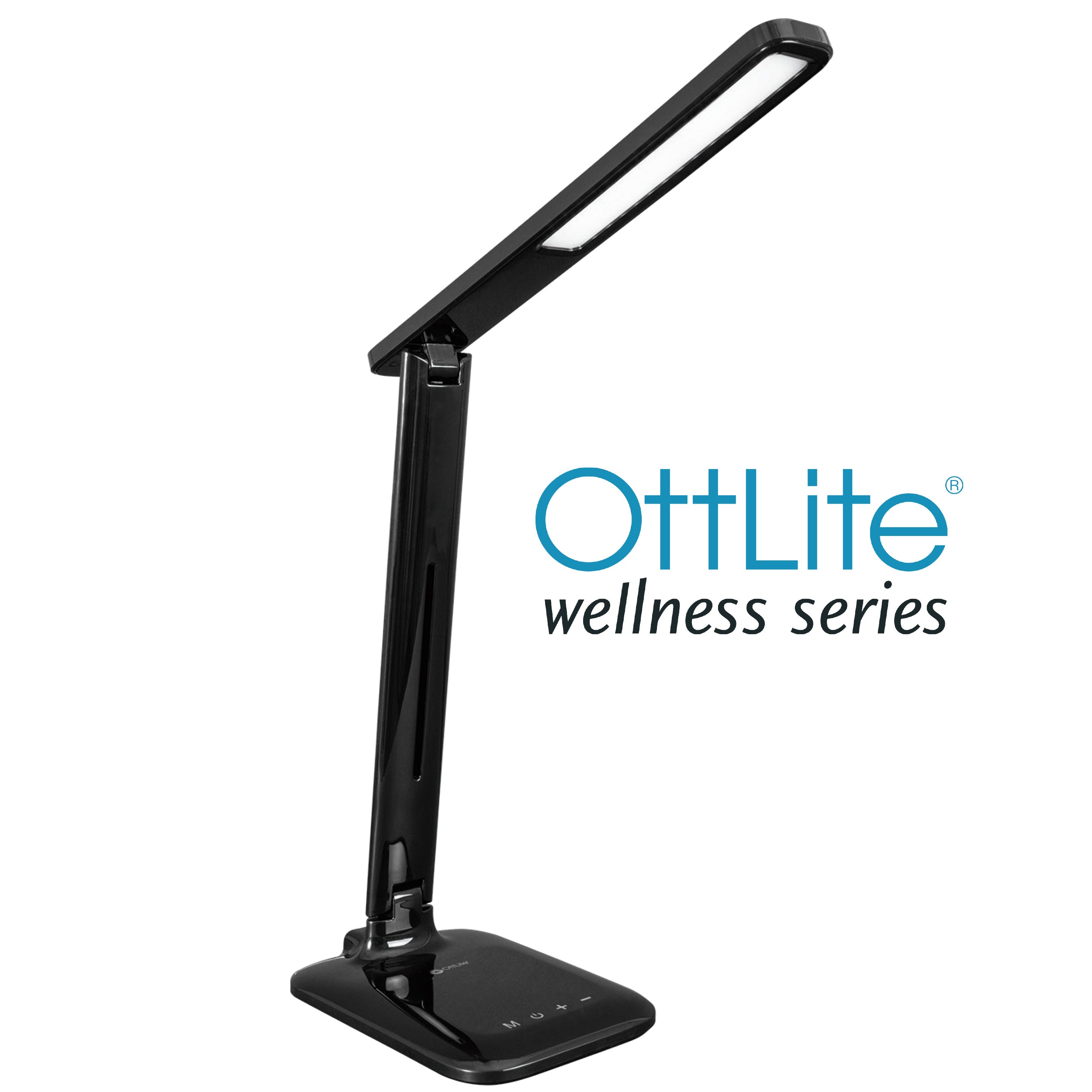
Explore this need in the finder →The current U.S. OttLite Slimline LED Desk Lamp page has two finish variants: Black CS336G5C-SHPR and White CS33600C-SHPR. The shared product record assigns a separate variant-bound lead image to each finish, and the linked instructions name both exact suffix codes. They are kept as finish variants within one functional assessment. This is the LED Slimline product; it is not the separately listed older 13 W Slimline Task Lamp with a replaceable bulb.
Compact tabletop geometry with two adjustment points
The manufacturer lists a base measuring 6.625 by 4.75 inches and a working height range from 5 to 19 inches. Its page describes two points of adjustment, and the exact Black and White photographs show the upright lamp body and separate hinged shade. Those details can help a buyer compare it with a fixed-height light or a larger multi-link arm, but a listed height is not a forward-reach measurement and does not confirm clearance over a particular display.
For questionnaire matching, the phrase “two points of adjustment” is not silently converted into two linked supporting-arm sections. The page names adjustment points, the manual distinguishes repositioning the lamp body from repositioning the shade, and the pictured upright body plus head do not establish a pair of linked support rods. The reviewed facts therefore leave the linked-section count unknown; the lamp is not included in the two-section finder result. It does have a documented tabletop-base arrangement, with no clamp or clip plan in its exact page/manual sources.
Color rendering, modes, and brightness
OttLite publishes a CRI of 95+ for this model. That clears the site’s maker-stated Ra 95 documentary threshold, but it remains a manufacturer claim rather than an independent measurement here. The page names three modes—warm white, bright white, and natural daylight—and five touch brightness settings. The manual describes the mode button and separate plus/minus brightness controls. It does not give numerical Kelvin values, nor does it assign a separate lumen output to each step.
This feature set is distinct from both a high-lux coverage specification and an automatic sensor. No exact product source states a 90 cm width at 500 lux or center illuminance at a stated height. The lighting modes are selected at the lamp; neither the page nor the model-specific instructions describe ambient paper and screen sensing. A published CRI value does not imply the width of the lit work area, and three selectable color labels do not mean that the lamp will automatically adapt to changing paper or monitor conditions.
Power, package, and service checks
The instructions describe a fully assembled lamp that connects to its supplied power adapter and a standard 120 V outlet. The adapter specification lists a 100–240 V, 50/60 Hz input and a 5 V / 1 A output. No battery-powered arrangement, Qi pad, or wired USB device-charging output is established in the exact sources. A small base and a low listed height may be useful in a crowded layout, but neither tells you where the power cord will fall or whether the head clears a monitor.
The manual says the consumer cannot replace the lamp head and separately warns that the LED light source is not replaceable; when the source reaches its end of life, the whole luminaire must be replaced. Those details make serviceability a meaningful tradeoff against the CRI claim and compact adjustment. The listing’s claims about reduced eyestrain are OttLite’s own claims, not a clinical conclusion or a result tested by this site.
Decision
The Slimline is a reasonable source-supported candidate for a tabletop setup where a compact 6.625-by-4.75-inch base, 5-to-19-inch listed height, five brightness levels, three manual color modes, and maker-published CRI 95+ are more important than charging ports or a measured beam width. The Black and White versions share the documented function, but check the exact finish and suffix on the offer. Do not choose it on the assumption that two adjustment points equal two linked arm sections, that the warm/daylight labels are numerical color temperatures, or that CRI alone guarantees coverage. No handling, color-matching, photometric, stability, or durability test is claimed.
Key specifications
Key details at a glance
| Lowest listed color rendering index (Ra) | 95 |
|---|---|
| Brightness levels | 5 |
| Highest listed lamp height | 19 in |
| Power adapter included | Yes |
| User-replaceable light source | No |
| Lowest listed lamp height | 5 in |
| Qi device-charging pad | No |
Use the exact model’s instructions for operating limits, supplied equipment and version differences.
Sources for this review
Sources for this assessment


Put your desk requirements together
A lamp’s specifications are only useful when they fit your workspace. Use the finder to compare documented mount and adjustment arrangements.