
Your needs, this model
Does it fit your priorities?
Can it charge a phone both wirelessly and by cable?
The exact manual documents a 5 W Qi pad at the base and a separate 5 V / 2.1 A USB output. Qi charging requires a compatible device centered on the marked area; the lamp's supplied adapter, not the USB port, powers the lamp.
Explore this need in the finder →Can I change color temperature and brightness separately?
Yes. A tap changes the listed 2,700 K, 4,000 K and 5,000 K modes; pressing and holding changes brightness. OttLite does not state a fixed brightness-step count for this model.
Explore this need in the finder →Does the flexible neck satisfy a two-linked-arm-section requirement?
Not on the reviewed evidence. The exact page calls it a flexible neck, but the sources do not identify two linked supporting-arm sections; use the two-section filter only for arrangements whose support links are documented.
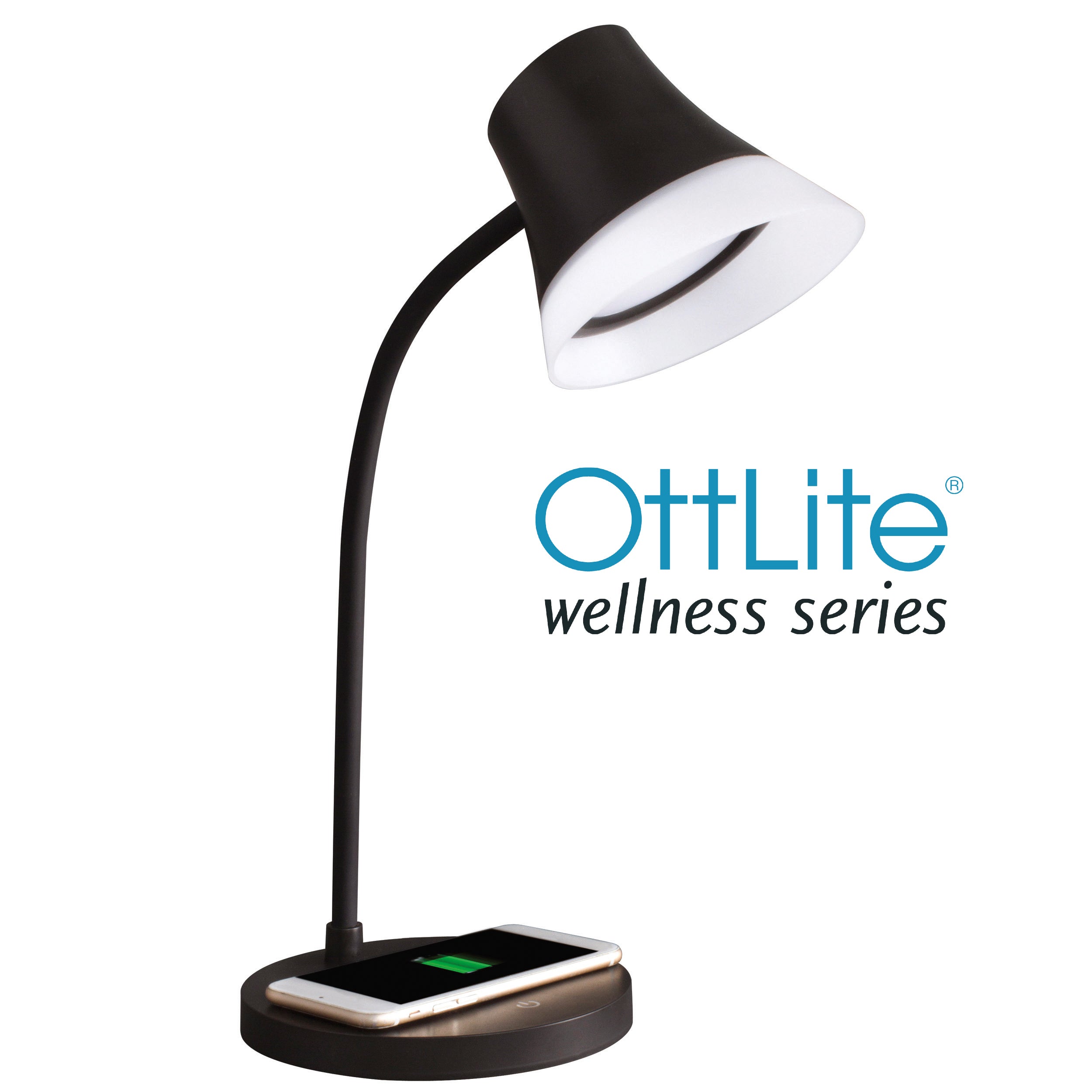
Explore this need in the finder →The Shine LED Desk Lamp with Wireless Charging is a single Black configuration, SKU CS03KQI-SHPR. Its useful question is not whether a charging base makes it a broadly capable task light, but whether its combination of manual aiming, three color-temperature choices and two device-charging routes suits a particular desk. This is a source-based assessment of the exact U.S. manufacturer page, product record and instructions; it is not a hands-on test.
A base and a flexible neck, not a jointed arm
The exact page describes a flexible neck with an overall listed height range of 12 to 17 inches and a six-inch-diameter base. That gives a rough starting point for desk clearance, but not a horizontal reach envelope or a light-coverage measurement. The neck allows the head to be redirected; the manufacturer does not document two linked supporting-arm sections, a clamp, or a clip. If your setup depends on clearing a monitor, shelving or a shallow shelf edge, compare the lamp's actual position against your layout rather than treating the height range as reach.
The manual says to steady the base and hold the body or shade when repositioning. That detail matters because this is a compact base-and-flexible-neck arrangement, not a long articulated arm whose joints can be individually adjusted. The six-inch base also occupies a fixed patch of desktop; the Qi phone pad sits in the center of that base, so the lamp, phone and any nearby desk tools must share the same surface. The official product image identifies the black shade, neck and base, but it cannot establish stability or light distribution.
Separate color selection from dimming
OttLite lists three manual color modes—2,700 K, 4,000 K and 5,000 K—and a maximum luminous-flux figure of 270 lumens. The instructions describe a tap of the touch switch to change color mode and a press-and-hold action to increase or decrease brightness. They do not give a fixed number of brightness steps, so the assessment does not invent one. Nor do the reviewed exact sources specify a 90 cm width at 500 lux or automatic paper and screen modes.
The page publishes CRI 95. That is useful if your decision rule is a maker-stated Ra threshold of 95 or higher, but it is not an independent sample measurement and does not tell you how much of your work surface will receive a particular illuminance. Kelvin selection and color rendering answer different questions: the former changes the selected white-light appearance; the latter is the manufacturer's reported color-rendering index. Neither substitutes for a stated beam-width-at-illuminance result.
Two charging paths with different requirements
At the base center, the manual documents a Qi charger rated at 5 V / 1 A, or 5 watts. A Qi-certified device needs to sit face up and centered on the charging mark; the indicator reports whether alignment is working, but the lamp does not report when the device is fully charged. Charging time varies by device, and the instructions note that a phone may become warm while charging. These are practical limits for a setup where the phone is not meant to be disturbed or where the phone case affects alignment.
A separate USB output is printed on the underside/rear area of the lamp base. The model-specific manual specifies 5 V / 2.1 A. The current product-page text has a malformed voltage/current phrase in its description, so the manual is the clearer exact-model specification for this port; buyers should still check the physical port and package before relying on it. The lamp itself runs from the supplied AC adapter, listed for 100–240 V input and 12 V DC / 2 A output. The USB port is device output, not an alternate lamp-power input.
What it does not establish
The integrated LED source is not described as consumer-replaceable, and the manufacturer rates the LEDs for up to 40,000 hours rather than promising a service life for every use pattern. A rated hour figure is not a repair plan. The exact sources also do not state a measured illuminance, a width at 500 lux, color-temperature memory, or an automatic response to paper and screen. The marketing description repeats an eyestrain-reduction claim; that is the manufacturer's wording, not an independent health conclusion in this review.
Who should compare it
Shine is a relevant comparison when you need a tabletop base, want to direct a flexible neck, prefer manual warm-to-cool choices, and have a Qi-compatible phone or a separate cable for the wired USB output. It is less compelling when a small base is not enough for your desk plan, when you need a long reach or a clamp, or when replaceable light sources and a documented wide field are essential. The reviewed retail record identifies one Black variant, CS03KQI-SHPR; do not treat a similar OttLite lamp or another wireless-charging SKU as the same configuration.
Before buying, verify that the exact SKU and supplied adapter match the offer, measure the six-inch base and the available 12–17-inch height space, check whether your device supports Qi, and test the center-pad position against the phone and its case. The published CRI, lumen maximum and LED-life rating are manufacturer specifications, not independent tests. The model's strengths are its unusually explicit combination of manual lighting choices with both Qi and wired charging; its main limitation is that those convenience features do not answer the harder questions of reach, replacement, or measured coverage.
Key specifications
Key details at a glance
| Lowest listed color rendering index (Ra) | 95 |
|---|---|
| Lowest color temperature | 2700 K |
| Highest color temperature | 5000 K |
| Documented tabletop arrangements | Tabletop base |
| Highest listed lamp height | 17 in |
| Listed base diameter | 6 in |
| Power adapter included | Yes |
| User-replaceable light source | No |
| Maximum listed luminous flux | 270 lm |
| Lowest listed lamp height | 12 in |
| Qi pad maximum output (device-dependent) | 5 W |
| USB device-charging output | 5 V |
| USB device-charging current | 2.1 A |
| Qi device-charging pad | Yes |
| Qi-certified device required | Yes |
Use the exact model’s instructions for operating limits, supplied equipment and version differences.
Sources for this review
Sources for this assessment
- OttLite Shine LED Desk Lamp with Wireless Charging official U.S. product page
- OttLite Black CS03KQI-SHPR Shine product and variant record
- Shine LED Desk Lamp with Wireless Charging instructions naming CS03KQI-SHPR
- OttLite official U.S. Desk Lamps product collection record
- OttLite Black CS03KQI-SHPR official product-page image

Put your desk requirements together
A lamp’s specifications are only useful when they fit your workspace. Use the finder to compare documented mount and adjustment arrangements.