
Your needs, this model
Does it fit your priorities?
Does the Black Renew publish Ra 95 for color-detail work?
OttLite publishes CRI 95 for F1DY8G59-SHPR. It meets the finder’s documentary threshold; this is the manufacturer’s value, not an independent measurement.
Explore this need in the finder →Does its 400-lumen maximum prove a 90 cm width at 500 lux?
No. The page lists maximum lumens but does not specify a width at 500 lux, so total luminous flux cannot satisfy that separate coverage threshold.
Explore this need in the finder →Is Renew a clamp or two-section-arm lamp?
The manual documents a tabletop base and movement of the lamp body and shade, but does not document a clamp or count two linked supporting-arm sections.
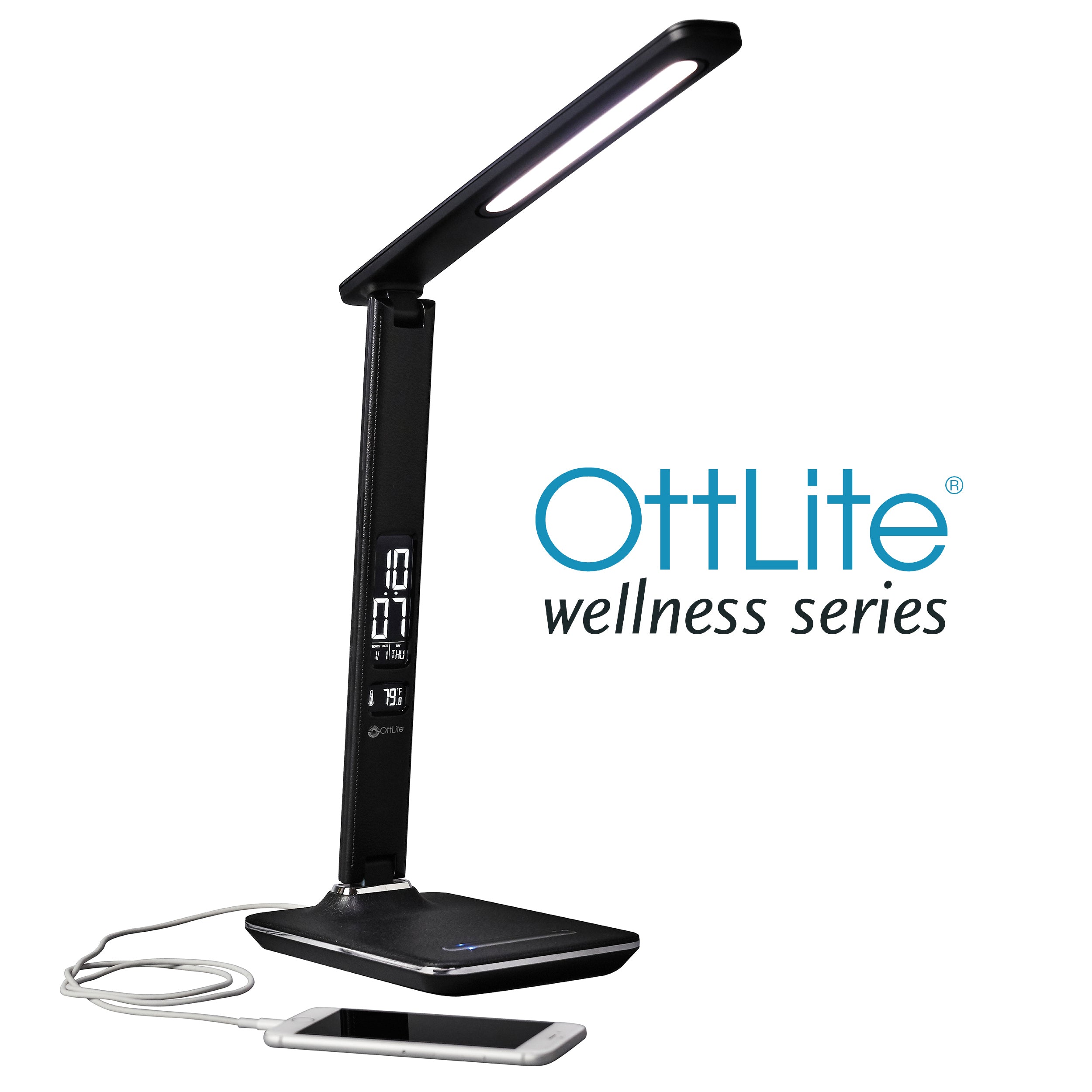
Explore this need in the finder →The OttLite Renew LED Desk Lamp in Black (F1DY8G59-SHPR) is built around an unusually information-heavy lamp body: besides the integrated LED and adjustable shade, its upright carries a clock, date, temperature display and alarm. The current U.S. page and the matching model instructions identify this exact black configuration. This assessment compares the maker’s published specifications with the manual’s setup and service details; it is not a hands-on test or a claim about measured light quality.
A display is the distinctive extra
Renew combines six touch-controlled brightness levels with a display for date, time and ambient temperature, plus an alarm. The controls are on the rear of the lamp body rather than a separate remote. If a visible clock or alarm is useful at a desk, that is a more meaningful reason to consider this model than the general “wellness” branding. The manual lists a CR2032 coin cell for the display/alarm backup function; that cell is not a battery-lighting system, and the lamp itself still uses its supplied power adapter.
The manufacturer lists a 400-lumen maximum and CRI 95. Those figures can help compare the published claims, but they are not a measurement made here. More importantly, the page does not give a beam width at 500 lux, a center illuminance at a stated height, or automatic paper-and-screen sensing. A 400-lumen maximum is total output language, not proof that the fixture covers a 90-centimeter desk area at the finder’s 500-lux boundary. The CRI figure qualifies for the published Ra 95 threshold, but it does not establish a broad beam or glare-free screen placement.
How the light is aimed
OttLite lists a height range from 7.5 to 14.75 inches and a base measuring 5.5 by 7.25 inches. The manual says to hold the base and reposition either the lamp body or shade, and warns against forcing those parts outside their permitted adjustment range. This creates more than one aiming movement, but the sources do not count two linked supporting-arm sections. It should not be treated as a two-section swing-arm lamp solely because the body and shade both move. Check the base’s longer 7.25-inch dimension against the actual free space on the desk, then look for a manual diagram if monitor clearance depends on the lamp’s reach.
There are six brightness levels but no published numeric Kelvin selection on the exact product page or manual. That makes Renew a different choice from a model that documents multiple color temperatures: its sourced differentiators are the display, alarm, CRI statement and listed lumen maximum. The page attributes an eyestrain-reduction claim to ClearSun technology; this review does not treat that promotional claim as independently measured comfort or health evidence.
Power, USB and service
The lamp is corded. Its manual specifies a supplied adapter with 100–240 V AC input and 27 V DC, 1 A output. A separate 5 V, 2.1 A USB port at the rear underside of the lamp body is for device charging; it does not power the light or make it cordless. If a phone cable will be used at the same time as the display, consider where both cords would run and whether the 5.5-by-7.25-inch base occupies useful writing space.
The instructions say to use only the supplied adapter, keep the unit indoors and avoid touching the LED panel after extended operation because it may become hot. The lamp head is not consumer-replaceable. Treat the CRI and lumen values as maker-published specifications and check the exact adapter, display parts and return terms for the precise SKU rather than assuming a visually similar Renew package is identical. The coin cell backs up display settings; it does not substitute for the AC adapter during lighting use.
When it makes sense to compare
Renew belongs on a shortlist when a desk-side clock, date, temperature readout, alarm, multiple brightness steps and wired USB output are more useful than a bare task light. The Black F1DY8G59-SHPR is a base-mounted lamp, so it does not answer a clamp or clip requirement. Its body-and-shade articulation is not documented as two linked arms, and the exact source set does not establish either a 90 cm width at 500 lux or automatic paper/screen modes.
Before choosing it, check the 7.25-inch base dimension, outlet and USB-cable route, and where the rear control panel will sit. If your work depends on selectable Kelvin settings, a quantified coverage width or a clamp, compare those exact conditions separately rather than inferring them from Renew’s display or total-lumen rating. The official product image supports the black lamp’s visible configuration; it says nothing about the quality of the display, USB charging, alarm sound, stability, or real-world light output.
Key specifications
Key details at a glance
| Lowest listed color rendering index (Ra) | 95 |
|---|---|
| Brightness levels | 6 |
| Documented tabletop arrangements | Tabletop base |
| Highest listed lamp height | 14.75 in |
| Power adapter included | Yes |
| User-replaceable light source | No |
| Maximum listed luminous flux | 400 lm |
| Lowest listed lamp height | 7.5 in |
| USB device-charging output | 5 V |
| USB device-charging current | 2.1 A |
Use the exact model’s instructions for operating limits, supplied equipment and version differences.
Sources for this review
Sources for this assessment

Put your desk requirements together
A lamp’s specifications are only useful when they fit your workspace. Use the finder to compare documented mount and adjustment arrangements.