
Your needs, this model
Does it fit your priorities?
Does the Genie have a clamp option?
No compatible clamp arrangement is documented for Genie. BenQ explicitly says its Desk Clamp is not compatible with the Genie e-Reading Desk Lamp; the Genie package is a base-mounted desk lamp.
Explore this need in the finder →Is there a wide-coverage figure for this smaller lamp?
BenQ lists 90 cm (35.4 in) of width at 500 lux and 1600 lux center illuminance at a 45 cm height. Those are manufacturer specifications with stated conditions, not independent measurements of your workspace.
Explore this need in the finder →Can I shift between screen and paper light?
The product overview describes automatic ambient sensing for screen and paper modes as well as manual knob control of brightness and color temperature. The selected mode still depends on where and how the lamp is positioned.
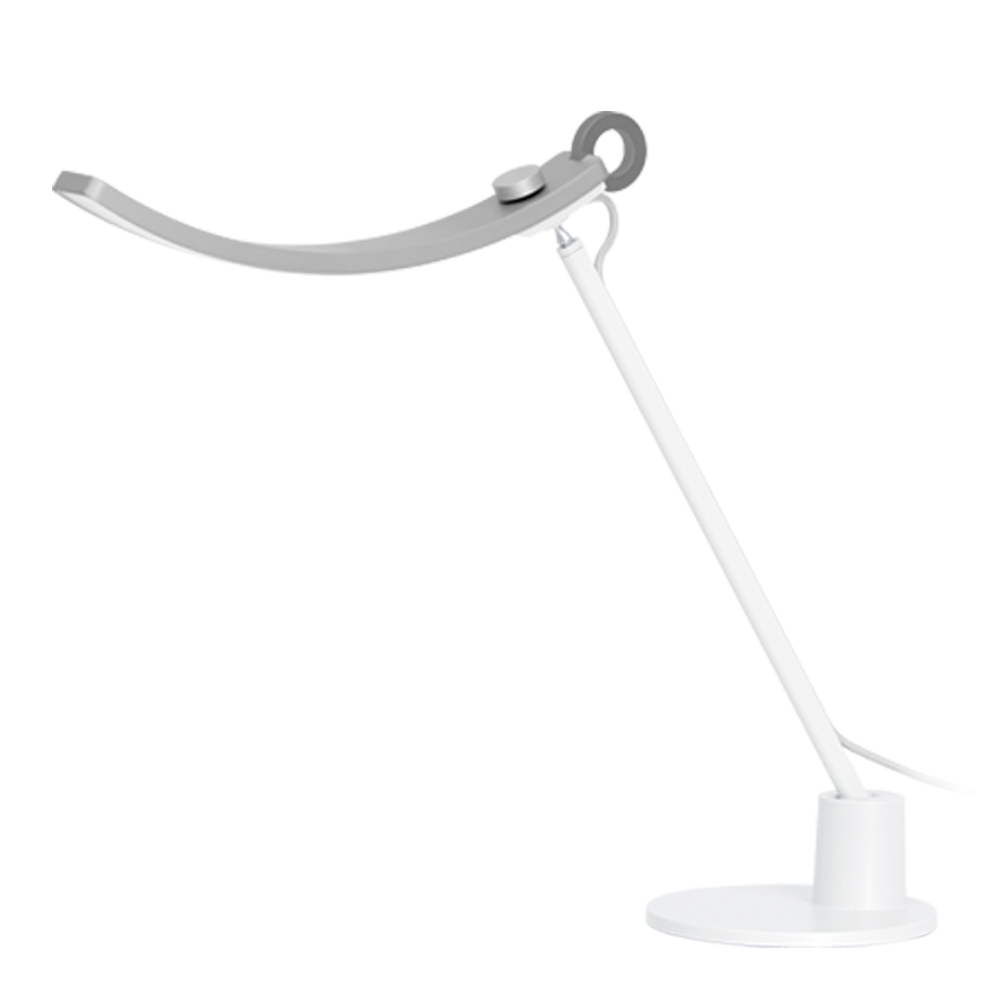
Explore this need in the finder →The BenQ Genie Desk Lamp (US model identifier GENIE-001, also called Genie Intelligent) is the compact, single-section-arm member of BenQ’s e-Reading desk-lamp group. Its listed body dimensions are 25 × 25 × 56 cm and its net weight is 2.5 kg. The product page describes an integrated LED head, a knob for brightness and color-temperature adjustments, and automatic screen/paper modes. This is research from BenQ’s current US product material, not a physical inspection or a claim that the lamp has been tested in a home office.
Compact listing, broad claimed light area
BenQ’s specifications give the Genie a 90 cm (35.4 in) lighting width at 500 lux and center illuminance of 1,600 lux at a 45 cm height. Those conditions matter: the numbers do not tell you the exact distribution at every point on a particular desk, or whether the head will clear your monitor and shelving. The relatively compact listed dimensions therefore should not be read as proof of a small beam—or proof that a 90 cm wide work area will be evenly lit in your room. Compare the published measurement basis, then check how the single arm can be positioned around the objects you actually use.
The manufacturer lists a Ra 95 color-rendering index and adjustable color temperature from 2,700 K to 5,700 K, in 13 levels, plus 23 brightness levels. The control knob dims the light and changes color temperature with a press-and-turn action. BenQ describes automatic ambient sensing for screen and paper modes. These features make the control system versatile on paper; they do not mean the sensor will choose the preferred setting for every person or every mix of monitor, notebook, and room light. Manual adjustment remains part of the design.
The small footprint comes with a fixed mount choice
The Genie’s single supporting arm is the clearest reason to choose it over the more articulated e-Reading Desk Lamp: there is less structure extending over the desk, and the listed envelope is smaller. That can suit a compact workstation where a multi-section arm would be visually or physically intrusive. It also limits how far the head can be repositioned compared with a lamp that has multiple linked arm sections. BenQ provides a ball-joint head, but the published pages do not specify an exact horizontal reach, joint travel, or obstruction clearance. If you need to move light between a wide keyboard-and-paper area, compare the actual head path before selecting it.
The supplied tabletop base is the only confirmed desk arrangement in this review. BenQ explicitly says its Desk Clamp does not fit the Genie. That is an important buying check if saving desktop space is essential: a clamp made for the related e-Reading lamp cannot be assumed to fit this model. The US product page identifies the model as Genie and lists lamp, adapter, instructions, warranty, wrench, screw, and rubber trim piece in the box. Confirm the exact identifier and package for the seller’s offer rather than relying on a generic “BenQ desk lamp” heading.
Who should keep it on the shortlist?
The Genie is a reasonable research-based candidate for someone who wants automatic paper/screen choices and multiple manual settings in a relatively short desk lamp, and who is content with a base on the tabletop. Its similarity to the larger e-Reading lamp is real: the manufacturer lists the same 90 cm coverage at 500 lux, 1,600 lux center reading at 45 cm, Ra 95, 2,700–5,700 K range, and 18 W maximum. Its difference is more about the support geometry and accessory compatibility than a clear numerical light-output advantage.
The tradeoffs are limited arm articulation, no documented clamp route, and an integrated LED source rather than a conventional replaceable bulb. BenQ’s US lighting information says its LED sources are not user-replaceable, so check what support route applies if repairability matters. Its stated input is 100–240 V at 50/60 Hz, and its maximum power consumption is 18 W. The official specification page lists aluminum alloy and engineering resin as materials. No claim here establishes actual brightness, glare, flicker, noise, durability, or longevity in a particular room. If a clear desktop without a base is non-negotiable, the e-Reading Desk Lamp’s compatible separate clamp is the more relevant option; if compact, base-mounted light is the priority, compare the Genie’s exact height and head path with your monitor and shelf clearances before buying.
Key specifications
Key details at a glance
| Manufacturer-stated width at 500 lux | 90 cm |
|---|---|
| Center illuminance at 45 cm | 1600 lx |
| Lowest listed color rendering index (Ra) | 95 |
| Lowest color temperature | 2700 K |
| Highest color temperature | 5700 K |
| Brightness levels | 23 |
| Linked arm sections | 1 |
| Maximum power | 18 W |
| Maximum listed width | 25 cm |
| Maximum listed depth | 25 cm |
| Maximum listed height | 56 cm |
| Net weight | 2.5 kg |
| Documented tabletop arrangements | Tabletop base/chassis |
Use the exact model’s instructions for operating limits, supplied equipment and version differences.
Sources for this review
Sources for this assessment
Put your desk requirements together
A lamp’s specifications are only useful when they fit your workspace. Use the finder to compare documented mount and adjustment arrangements.